AFL
Why No Two AFL Grounds Are the Same Size, and What That Does to the Game
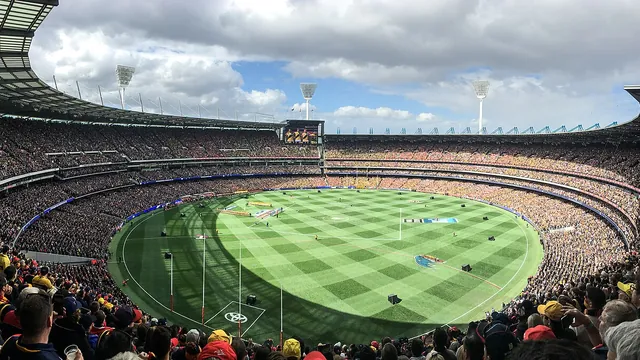
Each AFL game takes place on a ground of a different size. One weekend, North Melbourne may catch themselves having to cover loose ball late in…
In Australian Rules Football’s (AFL) season, clubs are first ranked by premiership points and then by percentage when the points are equal. A win is worth four premiership points, a draw two, and a loss zero. The ladder percentage is calculated using this formula:
SESA Sport desk · 2 September 2026 · 1052 words

AFL ladder percentage = (total points for ÷ total points against) × 100
For example, if your club has scored 900 points and conceded 750, its percentage is 900 ÷ 750 × 100 = 120%. Percentage is central to reading the ladder because if two or more teams have the same premiership points, the one with the higher percentage sits higher.
In addition to the premiership points used in our example, let’s say the club with 900 for and 750 against has 10 wins, 2 draws, 6 losses, while the team with 850 for and 550 against has 10 wins, 2 losses. The first team has 4 × 10 + 2 × 2 + 0 × 6 = 44 points, while the second has 4 × 10 + 0 × 2 + 0 × 6 = 40 points. On the ladder, the 900 for 750 against team ranks higher, as it has the same number of wins but a higher premiership point total through avoiding further losses.
There are no further tiebreaks on the ladder beyond premiership points then percentage. As a result, ladder structures often show percentage to two decimal places. To further underscore that percentage is a points-for versus points-against ratio, a team that ends on 200 total points against can have a percentage of 50% (100 for, 200 against) or 200% (400 for, 200 against).
Percentage on the ladder is strictly the ratio of total points scored to total points conceded, multiplied by 100. A team on 100% has scored precisely as many points as it has conceded; above 100% indicates scoring more, and below, concessions exceeding scores.
There is confusion that percentage, or win percentage, is the number of wins divided by the number of games. This is not the case. In percentage, a single‑point win is counted exactly the same as a 200‑point blowout win.
This makes percentage important to a team’s late‑season maneuvering. Entering Round 22 with three wins, you may still be able to claim a top‑four spot. But when chasing percentage, victory margins matter because the top‑four teams will have the double‑chance in the first weeks of the finals.
The AFL finals series had an eight‑team format from 2000 to 2025. The top four teams qualify for the first week of the finals, where they play qualifying matches in a non‑elimination format. These matches provide a double chance to win the premiership, as the winners of the qualifying matches progress straight to the preliminary finals, while the losers drop to the semi‑finals. If the losers of the qualifying matches win the semi‑finals, they will then face the preliminary finalists in the preliminary finals.
The bottom four teams in the top eight, however, play elimination matches in the first week, and these matches are sudden‑death with no second chance. The winners of the elimination finals then face the losers of the qualifying finals in the semi‑finals, with the winners of the semi‑finals progressing to the preliminary finals.
The structure is as follows:
The winners of the qualifying finals advance to the preliminary finals, while the losers drop to the semi‑finals. The winners of the elimination finals then face the losers of the qualifying finals in the semi‑finals. The winners of these two semi‑finals join the two qualifying‑final winners in the preliminary finals.
The four preliminary finalists then compete for a Grand Final place. This is how the finals series guarantees the top four sides a double chance to win the premiership, while the bottom four sides must win every match they play.
The winners of the top four qualifying finals are guaranteed a spot in the preliminary final, whether or not they win their qualifying final. But the bottom four sides have to win every match they play, four in total, to be crowned premiers.
The double chance, provided to the top four sides in the finals, is a significant advantage. To hit the big dance, those sides only need to notch up two wins - a qualifying final, then a preliminary. Meanwhile, 5th–8th must win four in a row, starting in elimination matches. There is no bottom‑side easy luck here - the challenge is steeper, and margin of error smaller, the further down the order you are. In the double chance for luck, this is what the system does.
This leads us to the next point. The AFL finals expanded from eight to ten teams for the 2026 season, after a quarter century of the top-eight structure. Teams now finishing 1st to 6th in the regular season go directly into the finals and get a week off, while those 7th to 10th don’t get such a rest - they play wildcard matches (7 v 10, 8 v 9) for the last two finals spots.
Once the finals field is set, the “traditional” final eight system kicks in as before, with 1st–4th on a double chance. The difference is that 5th and 6th also now automatically make the finals, instead of having to reach it through an elimination match. They don’t have the same double-chance for their first finals match (it’s a sudden‑death elimination knockout for both 5th and 6th).
In the final two rounds of the season, the ladder may tighten. But knowing the percentage formula and how it interprets points for and against gives teams guidance on what they need. Winning big helps, whether your club has the top points total or is chasing another in the same premiership‑points band. With three games left and 100% behind a fellow 12‑win team, a 50‑point victory enables winning the percentage race.
The ladder shows teams what they need. And the percentages reflect that, run‑to‑run, week after week, over the whole season. The key is remembering the formula: Total points for ÷ total points against × 100 = your percentage.
AFL
Each AFL game takes place on a ground of a different size. One weekend, North Melbourne may catch themselves having to cover loose ball late in…

AFL
The Australian Football League Women's (AFLW) competition has undergone a significant transformation in recent years, with the 2023–2027…

AFL
The Brownlow, the Coleman and the Norm Smith medals are the individual awards that preempt the AFL finals series each year, but each has a…