Cricket
The Sheffield Shield: How Australia's First-Class Season Makes Test Players
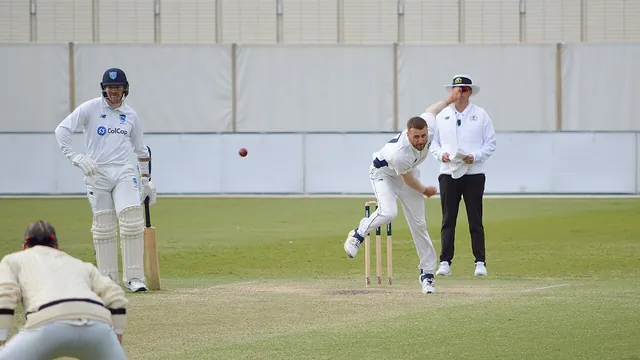
The Sheffield Shield stands as Australia’s premier first-class cricket competition, serving as the nation’s primary pathway into the Australian…
Rain does not just shorten a cricket match: it reshapes the contest. When wet weather interrupts an innings, the Duckworth-Lewis-Stern (DLS) method swings into action. It does not simply reduce the required runs proportionally; it recalculates the chase by adjusting for the overs and wickets remaining to each side.
SESA Sport desk · 12 July 2026 · 482 words
The International Cricket Council (ICC) spells out how DLS works, saying the model adjusts the score in proportion to the remaining resources of each team 1,2,3,4/REF.
So what are these resources? At the start of a 50-over innings, a side has 100% of its resources – 50 full overs to bat, plus all ten wickets intact. Those two factors, overs and wickets, are the building blocks of the entire DLS calculation 5,6,7,8/REF. With each wicket loss or over bowled, those resources are used up.
When is DLS used?
The ICC uses the model in all its official matches, from ODI series to the T20 games. It kicks in whenever time is lost due to actions beyond the team's control, but principally when rain reduces the time available for play. The full rules are set out in the ICC Men's ODI Playing Conditions, effective from July 2025 11/REF.
What are par scores and targets?
The most common confusion about DLS is, "Did the target go up or did it come down?" The answer is usually that the target itself is a fixed number, set at the time of the rain interruption and adjusted once only.
In the chase, the click-by-click benchmark is the par score and the table listing overs against Resource % is what the commentators refer to 8,9,12,13/REF. A par score is what the team must reach at the moment of the interruption. If the score is above the par, the chasing team are in front. If they are below, they are trailing 10,14,15,16/REF.
After the interruption, the par will continue to change with every wicket lost, every boundary hit and run scored. The fixed revised target will stay just that - fixed 8,9,17,18/REF.
Why does the target sometimes go down?
The target can drop because the chasing team has used resources to get them to their existing score: so it is a smaller fraction of the original target to chase. It is not common, but it does happen: notably in one closely fought World Cup final 19,20,21/REF.
And can it go up as well?
Yes. If it is Team 1’s innings that is interrupted, their short defending total will be the foundation of the revised target. With a reduced version of the defending total, that would then be carried on the DLS formula: and so Team 2 with their full quota of overs lead throughout 4,22,23,24/REF.
It happens less often, but it is is part of the way the formula is designed to work: to even up sides. Team 2 gets to play the second half of the game with the reallocated available resources.
For the non-specialist, the bottom line is the chase. If the chasing side is ahead of par at the moment of the interruption, then they won at that point - even if overs remain to be played. All else is commentary and context.
Cricket
The Sheffield Shield stands as Australia’s premier first-class cricket competition, serving as the nation’s primary pathway into the Australian…
Cricket
The Big Bash League (BBL) fundamentally transformed its rules in November 2020, introducing three bold innovations – Power Surge, Bash Boost…
Cricket
Australia's modern cricket pathway is a structured, multi-stage system. It moves players from junior club and state programs, through underage…